
Moving Between Fixed and Flow
Barkha Gupta
“The stone remains, the river moves, and the landscape exists somewhere between the two. What appears fixed is never entirely still; what flows is always leaving a trace.”
If this body of work is a conversation, it begins with Barkha Gupta looking at Hampi, and Hampi slowly answering back.
Barkha returns to Hampi for the fourth time, bringing earlier memories of boulders, fields, architecture and light into contact with the journeys, discoveries and encounters of her time at Hampi Art Labs. The Hampi she carries with her is shaped by these experiences, held together through memory and looking.
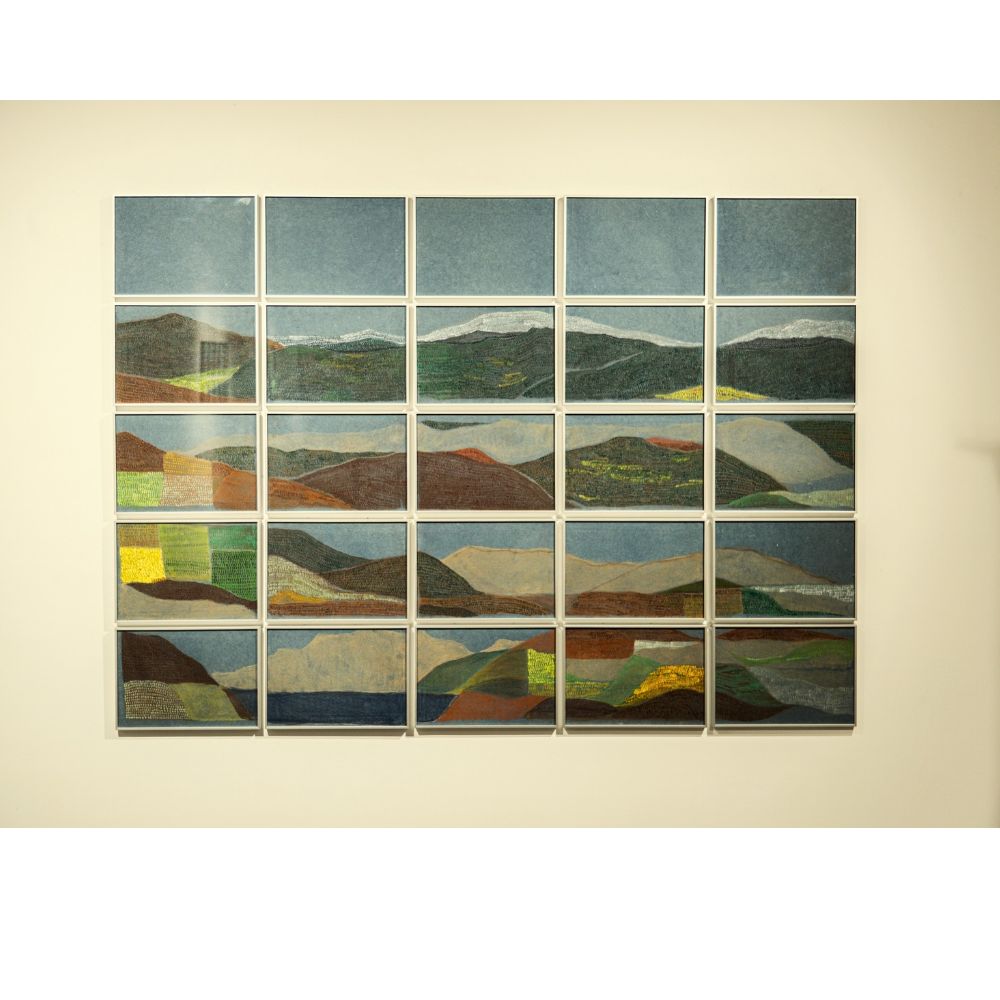
Growing up around architects and floor plans, Barkha learnt to see space first as something drawn, flattened and translated onto a surface. Drawing and mark-making became an instinctive way of understanding and translating what she saw. At Hampi, this way of looking meets a place already marked by water, movement, architecture and human use. What catches her attention is not the landscape as a whole, but the smaller elements through which it takes shape: marks on granite flooring, the patterns of rice fields, the rhythms of agricultural land. Gradually, these begin to recall the patterns of embroidery. The landscape appears not as a single, continuous image, but as something assembled from many smaller elements, much like a surface built through stitching.
“My attention edits the landscape. What stays with me are textures, repetition, rhythm, colour, density, darkness, light, grids and interruptions.”
During her residency at Hampi Art Labs, Barkha made frequent journeys to Kaddirampura, travelling nearly 90 kilometres on each round trip to meet and work with the Lambani community. From the moving car, fields, vegetation, quarries, architecture and changing light passed before her in shifting colours, shadows, silhouettes and rhythms. It was during this time that Barkha unexpectedly recognised Mangali Bai, lovingly called Amma, whom she had first met as a student in 2015. Nearly eleven years later, their paths crossed again while she was working with Shanti, Lakshmi and Girija Bai from the Lambani community. This felt serendipitous, almost as though a memory had found its way back to her. Hampi was no longer held only in the landscape Barkha observed, but also in the lives and memories of the people she met there.
Perhaps this is how Barkha and Hampi continue to understand one another. Through each return, each material and each mark, the landscape changes, and so does the way she sees it.
Priyanka Sil